Reimagining Payer Contract Management with Agentic AI
Helping contract experts find what matters, understand the financial impact, and safely share predictable work with AI.
Payer contracts define how insurance companies pay hospitals. A small change to a rate or rule can affect millions of dollars.
I led the design of an AI-assisted contract experience that helps experts find the changes that matter, model their impact, and focus their attention where mistakes cost the most.
- Role
- Lead Designer
- Team
- 4 Product Managers · 37 Developers · 6 Data Scientists
- Year
- 2026
- Impact
62% faster financial insight
62% less rework
78% more contracts per analyst
~$8M new booking value
Watch the quick overview
A quick overview of how an automation brief became a way to share work between AI and experts.
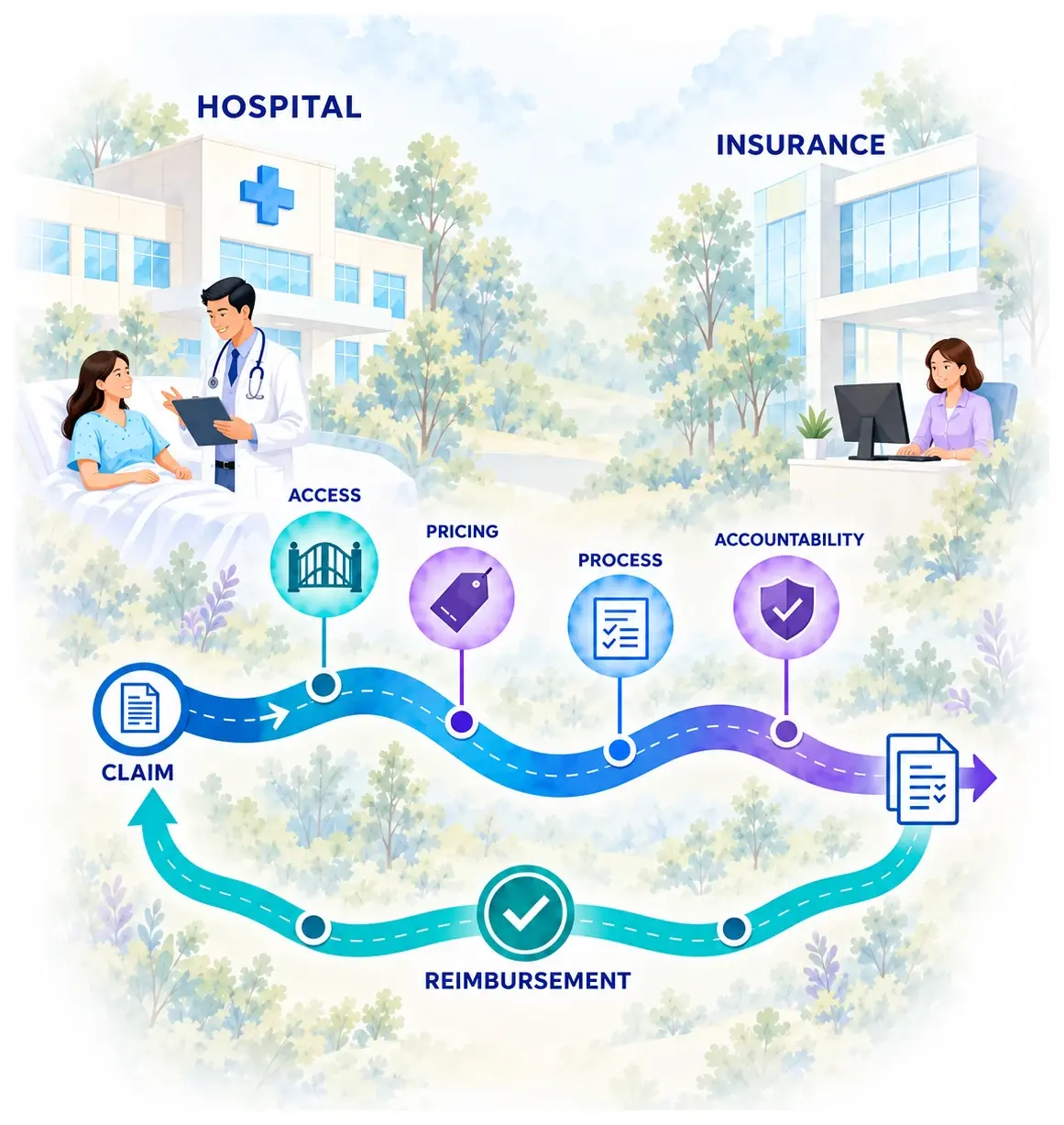
The contract is the map from care to payment
A payer contract tells the hospital how it will be paid.
It holds rules for rates, thresholds, carve-outs, and fee schedules. Those rules become system settings. If the reading or the setup is wrong, the expected payment is wrong too.
A contract is not just a document. It becomes the logic behind reimbursement.
Meet the Contract Manager
Contract Managers turn complex payer agreements into something the hospital can use.
This is not a document-processing job. It is a financial decision-making job.
- Understand
- Rates · Thresholds · Carve-outs · Fee schedules · Payment rules
- Evaluate
- What changed · What matters financially · Which claims are affected
- Configure
- Turn contract terms into system rules
- Validate
- Test expected payment · Investigate differences
- Negotiate
- Use financial evidence for renewals and payer talks
It looked like a document problem. It wasn't.
Contracts are long, and AI can read documents, so automating extraction seemed natural. Research showed that reading the contract was only the beginning.
The terms that matter were buried
A contract can hold hundreds of terms. Only some change the payment, but experts still reviewed most of them.
Find the few terms that change the money.
- ~82%
- of surfaced terms reviewed by hand
Use the ← → keys, click an edge, or scroll sideways.
The terms that matter were buried
A contract can hold hundreds of terms. Only some change the payment, but experts still reviewed most of them.
Find the few terms that change the money.
Before automation- ~82%
- of surfaced terms reviewed by hand
Before: most terms get reviewedHundreds of termsA few change the paymentA found term did not show its cost
Knowing a threshold moved from $200K to $225K is useful. Experts still had to work out which claims it hits and by how much.
Extraction tells you what changed. Modeling tells you whether it matters.
Before automation- 95 min
- to reach a useful financial insight
- 2.8 days
- to prepare model-ready analysis
BeforeThreshold$200K → $225K- How many claims cross it?
- How much does payment change?
- Which services are exposed?
Setup was fully manual
After signing, analysts typed contract language into structured system rules. A wrong setup could still look valid.
Setup errors were easy to make and hard to see.
Set up by handRatesThresholdsCarve-outsFee schedulesExclusionsEffective datesPayer rulesA wrong setup can still look valid.Mistakes were found too late
A wrong threshold or mapping may not show an error until test pricing looks wrong or a payment gap appears.
The problem was finding mistakes downstream.
Before automation- 21%
- of analysis needed rework
Before: fixing it meant going around again- Contract
- Interpret
- Configure
- Test
- Problem found
Automation raised a new question: when should AI be trusted?
AI could prepare work much faster. But one wrong reading of an important term could cause a large error later.
The challenge was deciding how much responsibility AI should have.
Before automation- 3.1 / 5
- decision confidence
What experts told usComfortable delegating- Predictable work
Less comfortable- Ambiguous language
- Unusual structures
- Low-confidence readings
- Big financial decisions
Analysts did not want AI to review contracts for them. They wanted AI to help them know what deserved their review.
Research changed the question
“How might we automate contract management?”
“How might we help Contract Managers:
- find the changes that matter financially,
- understand their impact,
- set up contracts safely,
- and share predictable work with AI?”
The goal was not maximum automation. It was better use of expert attention.
Four things needed to improve
- Goal 1
Find what matters
Spot the financially important terms without reviewing everything.
- Goal 2
Reach financial insight faster
Connect contract language to claims, scenarios, and payment impact.
- Goal 3
Configure correctly earlier
Catch wrong readings before they become rework.
- Goal 4
Focus human review
AI handles predictable work. Experts handle ambiguity and big financial impact.
Keep important decisions accountable
AI prepares the work. The analyst can still inspect, correct, override, and commit.
Automate the predictable. Surface the consequential.
Five principles guided the design.
- 01Prevent, don't repair
Catch errors upstream, not downstream.
- 02Automate predictable work
Don't spend expert attention on routine answers.
- 03Make ambiguity visible
Show where AI is unsure.
- 04Design authority
Decide when AI leads and when people do.
- 05Scale the learning
Reuse the rules across the lifecycle.
How the design answered each goal
One answer for each goal, then one trust model across the whole lifecycle.
AI surfaces the terms that deserve attention
AI compares the proposal with the current contract and flags the few terms that matter.
The analyst focuses on what deserves judgment.
Connect contract language directly to financial impact
AI prepares the analysis. The analyst checks the assumptions and weighs the trade-offs.
Finding the term is not the outcome. Understanding the financial consequence is.
AI prepares the setup. Experts check the risky parts.
- 1Upload contract
- 2Review terms
- 3Resolve issues
- 4Test price
- 5Activate
AI maps terms to settings, flags the uncertain ones, and tests expected payment. If AI is wrong, the analyst fixes that one decision and keeps going.
Catch reading errors before they become payment problems.
Recovery should be local
If AI keeps misreading one decision, the analyst takes more control for that decision only. Once it is fixed, the workflow returns to normal.
AI can lose authority locally without losing usefulness everywhere.
Move from verify everything to verify what matters
Review shifts toward ambiguous terms, low-confidence readings, unusual structures, and big financial changes.
Routine work gets less expert time. High-impact work still gets scrutiny.
Tiles stand for surfaced terms. Review moved to the ambiguous and high-impact ones.
One trust model across the contract lifecycle
Should we accept this proposal?
- 1AI: Finds changes
- 2AI: Prepares scenarios
- 3AI: Models impact
- 4Person: Interprets trade-offs
- 5Person: Chooses the negotiation strategy
Use the ← → keys, click an edge, or scroll sideways.
Should we accept this proposal?
- 1AI: Finds changes
- 2AI: Prepares scenarios
- 3AI: Models impact
- 4Person: Interprets trade-offs
- 5Person: Chooses the negotiation strategy
Did we translate the signed contract correctly?
- 1AI: Extracts terms
- 2AI: Maps settings
- 3AI: Flags issues
- 4Person: Resolves ambiguity
- 5AI: Prepares test pricing
- 6Person: Checks the consequential terms
- 7Person: Activates
Is the contract still behaving as expected?
- 1AI: Sorts deviations
- 2AI: Links variances to likely terms
- 3AI: Prepares the investigation
- 4Person: Investigates exceptions
- 5Person: Finds the cause
- 6Person: Decides the fix
Did we achieve the goals?
Find what matters
Less review overall. More attention where it mattered.
Reach financial insight faster
Contract language reached financial analysis much faster.
Configure correctly earlier
More problems were caught before they traveled downstream.
Focus human review
Experts relied on AI more selectively and felt more confident.
The same team handled more contracts
An observed before and after result.
New booking value
Easier to read, check, set up, model, and act on.
What changed in the work?
- 1
Find
Before: Read everythingAfter: Surface what matters
- 2
Understand
Before: Interpret by handAfter: AI prepares the reading
- 3
Model
Before: Assume by handAfter: AI prepares scenarios
- 4
Configure
Before: Write rules by handAfter: AI sets up, flags doubts
- 5
Validate
Before: Errors found lateAfter: Fix doubts early
- 6
Review
Before: Verify everythingAfter: Check what is risky
- 7
Recover
Before: Rework downstreamAfter: Fix one decision
- 8
Decide
Before: Rebuild the pictureAfter: Compare with evidence
Before, experts spent their time finding and verifying contract information.
After, they spent more of their time deciding what the contract meant financially.
The goal was never maximum automation
It started as a question about automating contract management. It ended as a model for when automation is right.
AI does more when the work is predictable. Experts take control when the language is unclear or the money at stake is high.
The outcome was not more trust in AI. It was better-calibrated trust.
AI handled more of the predictable work.
Experts focused on ambiguity, financial consequence, and final decisions.